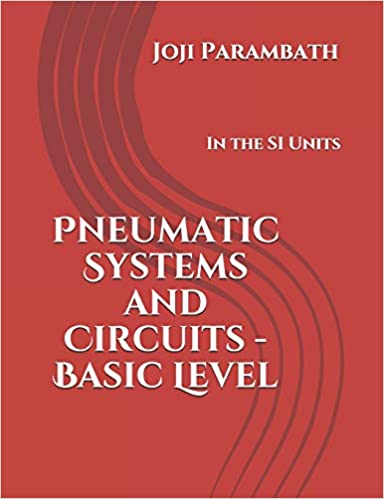
This blog provides self-explanatory, basic pneumatic circuits with only a single cylinder. Direct control of a single-acting cylinder Indirect control of a single-acting cylinder Speed control of a single-acting cylinder Direct control of a double acting cylinder Indirect control of a double acting cylinder Speed control of a double acting cylinder Memory control of a... Continue Reading →
Understanding Air Compressors โ Part 3
ย [Note: Part 1 of this article presents the basics of air compressors. Part 2 presents the classification and construction details of air compressors. Part 3 presents a brief about the sizing of air compressors.] Sizing Air Compressors Sizing an air compressor for an application requires a logical sequence of actions. The following steps highlight a... Continue Reading →
Understanding Air Compressors โ Part 2
[Note: Part 1 of this article presents the basics of air compressors. Part 2 presents the classification and construction details of air compressors. Part 3 presents a brief about the sizing of air compressors.] Classification of Compressors In a positive displacement compressor, air is confined within an enclosed space where it is compressed by decreasing... Continue Reading →
Understanding Air Compressors โ Part 1
[Note: Part 1 of this article presents the basics of air compressors. Part 2 presents the classification and construction details of air compressors. Part 3 presents a brief about the sizing of air compressors.] A power source in a pneumatic system generates and distributes compressed air to all of its actuators. A compressor converts mechanical... Continue Reading →
Know the Difference between Gauge Pressure and Absolute Pressure
Two pressure scales measure pressure values in fluid power systems: a gauge scale and an absolute scale. The gauge pressure is the pressure indicated by a pressure gauge. It is a measure of the pressure with reference to the atmospheric pressure (1.013 bar or 14.7 psi) and it is not with reference to the absolute... Continue Reading →
Configuring a Typical Pneumatic System
The schematic diagram of a typical pneumatic system is in the accompanying figure. Basically, the system is composed of a power source, control valves, and work elements. The power source can broadly be classified into compressed air generation, primary air treatment, storage, air distribution, and secondary air treatment. A compressor is a device for converting... Continue Reading →
Know the Most Economical Pressure in Pneumatics
What is the Most Economical Pressure in Pneumatics? Pneumatic systems have been developed and progressed comparatively as low-pressure systems. Pneumatic air-consuming devices such as cylinders and rotary actuators are designed for a maximum operating pressure of 8 to 10 bar [115 to 145 psi]. However, practical experience has shown that 6 bar [90 psi] is... Continue Reading →
Pressure Control Valves in Hydraulic Systems
The article looks at the basics of pressure control valves for educational use and is presented here to refresh your memory. Hope you can recall the functions, circuits, and applications of pressure control valves. Pressure control valves are used in hydraulic systems to obtain pressure-related control functions. ย Pressure control valves can be categorized into: (1)... Continue Reading →
Hydraulic Accumulators
A hydraulic accumulator mainly consists of a chamber in which a fluid is held under pressure by a spring, a raised weight, or a volume of compressed gas (nitrogen). It is, thus, possible to store potential energy in the accumulator, when the associated system pressure is greater than that of the accumulator. A hydro-pneumatic accumulator... Continue Reading →
Five Typical Applications of Hydraulics
The use of fluid power is widespread in many stationary and mobile applications. Many of the operators, technicians, and engineers are not well-versed in the operational, maintenance, and safety aspects of fluid power. Therefore, systematic training is essential for them to handle fluid power systems.ย Modern hydraulic technology can be used to make the brakes... Continue Reading →