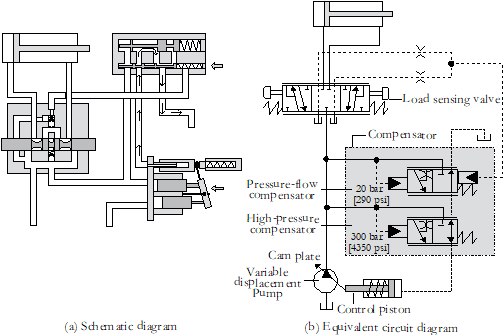
Load Sensing Hydraulic Systems

The hydraulic system with a load sensing feature provides only the flow and pressure required by the connected load. Controlling both the pressure and the flow allows for a significant reduction in losses, improvement of circuit efficiencies, and enhancement of the system's service life. A Typical Load Sensing System The basic load sensing system typically... Continue Reading →

Electro-hydraulic Servo Valve Systems

Hydraulic systems driven by servo valves provide highly accurate control over enormous forces. A servo valve system consists of a transducer, a servo amplifier, a servo valve, and an actuator with a connected load. It is a closed-loop system used to precisely control the output (load) parameter, such as position, velocity, or force, in response... Continue Reading →

What is Cavitation?

Cavitation is a harmful condition that occurs in a hydraulic system component like a pump or a valve when the existing space in the working component is not filled with the system fluid. It is the formation and collapse of vapor or air bubbles in the pumped fluid as it passes through the component. Undetected... Continue Reading →

Hydraulic Accumulators

A hydraulic accumulator mainly consists of a chamber in which a fluid is held under pressure by a spring, a raised weight, or a volume of compressed gas (nitrogen). It is, thus, possible to store potential energy in the accumulator, when the associated system pressure is greater than that of the accumulator. A hydro-pneumatic accumulator... Continue Reading →

Five Typical Applications of Hydraulics

The use of fluid power is widespread in many stationary and mobile applications. Many of the operators, technicians, and engineers are not well-versed in the operational, maintenance, and safety aspects of fluid power. Therefore, systematic training is essential for them to handle fluid power systems.  Modern hydraulic technology can be used to make the brakes... Continue Reading →

Fluid Power – Fascinating Points (#1)

Fluid power provides the muscle for various work operations in stationary and mobile applications. As we can see, the use of fluid power is widespread in many applications. However, many operators, technicians, and engineers are ignorant of the operational, maintenance, and safety aspects of fluid power. Therefore, proper training is essential for handling fluid power... Continue Reading →

Create a website or blog at WordPress.com

Up ↑