The basic concepts of a relay control system and a PLC control system are highlighted in this article with the help of a circuit diagram. Assume that an electro-pneumatic system is used to obtain an industrial work operation. The system consists of a pneumatic power part and an electrical control part. The electrical control part... Continue Reading →
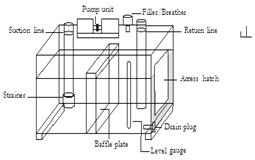
Hydraulic Reservoirs
Hydraulic Power Pack A hydraulic power pack transforms the power its prime mover conveys to hydraulic power at pressures and flow rates as required for all the system actuators. It is usually a compact, portable, and pre-configured assembly that contains components required to store and condition a given quantity of fluid and push part of... Continue Reading →
Hydraulic Fluid Contamination & its Control
Hydraulic fluids are subjected to various kinds of contamination (particles, water, air, compounds, and biological). Contaminants can affect fluids' physical and chemical properties. If the contaminants are not monitored or controlled, the fluid is likely to fail. A complete range of 36 textbooks, in Paperback & Kindle eBooks Editions, on Pneumatics and Hydraulics, under the... Continue Reading →
Hydraulic Fluids โ Functions, Characteristics, & Categories
Modern hydraulic applications demand compact machines designed with tighter tolerances and that run at faster cycle times. They are designed to work with small amounts of fluids. They operate at higher pressures, temperatures, and speeds. Under these circumstances, fluids are subjected to severe stresses. Hydraulic Fluids By Joji Parambath The textbook presents information on the... Continue Reading →
The Essence of Programmable Logic Controllers (PLCs)
A programmable logic controller (PLC) is a modern device that can control the work process in a machine or an appliance. The operations involved in the work process are carried out by actuators such as electric motors, pneumatic actuators, hydraulic actuators, etc., which are controlled by final control elements such as contactors, solenoid valves, etc.... Continue Reading →
Relay-based Electro-hydraulic Systems
In the electrical actuation of a hydraulic valve, the necessary actuating force is obtained electrically with the help of a solenoid. The off-centre core of the solenoid coil is pulled towards the centre of the coil when the electric current is passed through it. This discrete movement of the core is used to actuate the... Continue Reading →
Pressure Control Valves in Hydraulic Systems
The article looks at the basics of pressure control valves for educational use and is presented here to refresh your memory. Hope you can recall the functions, circuits, and applications of pressure control valves. Pressure control valves are used in hydraulic systems to obtain pressure-related control functions. ย Pressure control valves can be categorized into: (1)... Continue Reading →
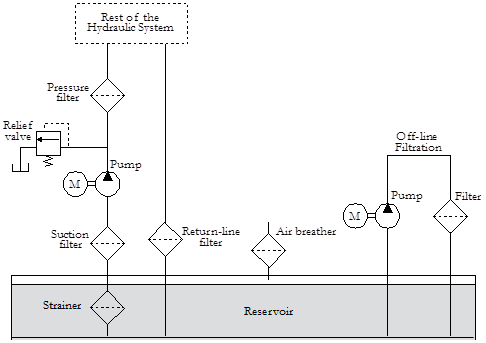
Hydraulic Filters
Hydraulic filters are vital components in hydraulic systems, ensuring they operate at peak performance and reliability. These filters effectively remove contaminants such as dirt, dust, and metal particles from the hydraulic fluid, which can otherwise lead to system failures or reduced efficiency.ย This article delves into the various construction features of hydraulic filters, highlighting the materials... Continue Reading →
Load Sensing Hydraulic Systems
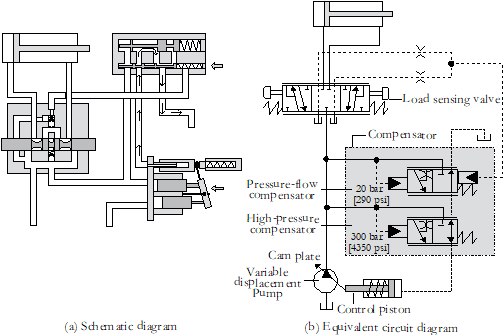
The hydraulic system with a load sensing feature provides only the flow and pressure required by the connected load. Controlling both the pressure and the flow allows for a significant reduction in losses, improvement of circuit efficiencies, and enhancement of the system's service life. A Typical Load Sensing System The basic load sensing system typically... Continue Reading →
Electro-hydraulic Servo Valve Systems
Hydraulic systems driven by servo valves provide highly accurate control over enormous forces. A servo valve system consists of a transducer, a servo amplifier, a servo valve, and an actuator with a connected load. It is a closed-loop system used to precisely control the output (load) parameter, such as position, velocity, or force, in response... Continue Reading →
Hydraulic Accumulators
A hydraulic accumulator mainly consists of a chamber in which a fluid is held under pressure by a spring, a raised weight, or a volume of compressed gas (nitrogen). It is, thus, possible to store potential energy in the accumulator, when the associated system pressure is greater than that of the accumulator. A hydro-pneumatic accumulator... Continue Reading →