Comprehensive Training in Pneumatics and Hydraulics!!
Lay a strong foundation,
Understand the concepts,
Master the circuits,
Learn the design,
Know the maintenance,
Troubleshoot for sure!!
Please contact:
Fluidsys Training Centre Pvt Ltd, Bangalore
+91 07338385505
email: info@fluidsys.in
Website: https://fluidsys.org
When designing hydraulic systems, you aim to get as much work done as possible while using less energy. You've got many design choices - from more traditional circuits to specialized arrangements like load sensing. High-end load sensing hydraulic systems offer better control and energy efficiency. Load sensing systems have become increasingly popular and widely accepted,... Continue Reading →
This blog provides self-explanatory, basic pneumatic circuits with only a single cylinder. Direct control of a single-acting cylinder Indirect control of a single-acting cylinder Speed control of a single-acting cylinder Direct control of a double acting cylinder Indirect control of a double acting cylinder Speed control of a double acting cylinder Memory control of a... Continue Reading →
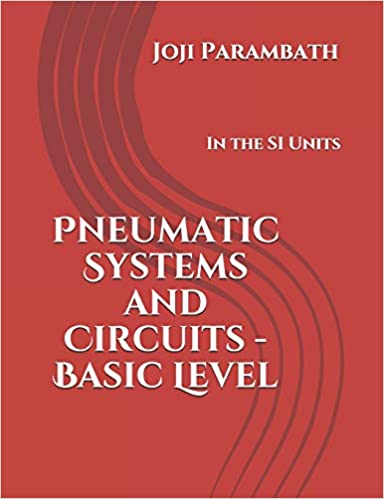
Textbook on ‘Pneumatic Systems and Circuits -Advanced Level’ By Joji Parambath The textbook presents information on the classification, constructional features, working and essential terms and definitions, sizing, and safety and maintenance aspects of hydraulic accumulators. The book uses the SI system of units. Please click on the image link to go to the Amazon.com Website... Continue Reading →
Fluidsys Training Centre Pvt Ltd., Bangalore Long-term Course Hydraulic and Pneumatic Systems – Advanced Level We are excited to introduce our long-term course on Pneumatics and Hydraulics. Duration: 12 weeks (4 to 6 hours per day, Monday to Friday) / Flexible timings Course Dates (2025): Please see our course calendar Eligibility: ITI / Diploma /... Continue Reading →
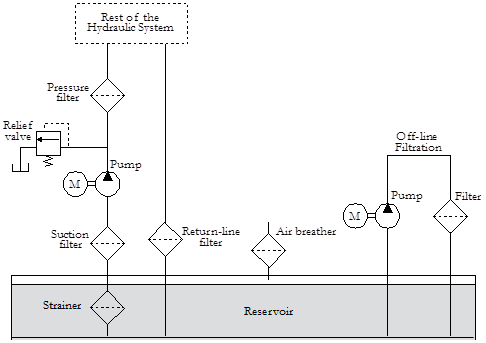
Filters must be integral parts of hydraulic systems to ensure the proper operation of the system’s pumps, valves, and actuators. As the hydraulic systems’ requirements are demanding, the prescribed cleanliness levels of their fluid media must be achieved under all operating conditions. For this reason, it is essential to understand the different types of hydraulic filters and their performance ratings.
A book authored by the Author presents the principles of filtration in hydraulic systems. These principles include the materials of filter media, various designs of filters, and the typical filter locations in hydraulic systems. Further, this book describes the filter element performance ratings, such as the beta ratio and efficiency, and the multi-pass test to determine such ratings.
The article explores the topic of hydraulic filters for educational use and is presented here to refresh your memory. Hope you are able to recall the constructional features, performance specifications, and location-based installation details of hydraulic filters quickly. Let us get down to the nitty-gritty of hydraulic filters…
Introduction
Modern high-pressure hydraulic systems with components built to closer tolerances are susceptible to many types of contamination. Contaminants can cause the premature wear of internal surfaces. They also promote leakage and clog the flow paths. Therefore, an efficient and correctly-sized filtration system should be an integral part of every hydraulic system to separate the particulate matter of a specified size or greater from the system fluid. They should be fitted at appropriate locations in the hydraulic circuit for the effective control of contamination.
The basic concepts of a relay control system and a PLC control system are highlighted in this article with the help of a circuit diagram. Assume that an electro-pneumatic system is used to obtain an industrial work operation. The system consists of a pneumatic power part and an electrical control part. The electrical control part... Continue Reading →
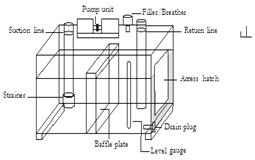
Hydraulic Power Pack A hydraulic power pack transforms the power its prime mover conveys to hydraulic power at pressures and flow rates as required for all the system actuators. It is usually a compact, portable, and pre-configured assembly that contains components required to store and condition a given quantity of fluid and push part of... Continue Reading →
[Note: Part 1 of this article presents the basics of air compressors. Part 2 presents the classification and construction details of air compressors. Part 3 presents a brief about the sizing of air compressors.] Sizing Air Compressors Sizing an air compressor for an application requires a logical sequence of actions. The following steps highlight a... Continue Reading →
[Note: Part 1 of this article presents the basics of air compressors. Part 2 presents the classification and construction details of air compressors. Part 3 presents a brief about the sizing of air compressors.] Classification of Compressors In a positive displacement compressor, air is confined within an enclosed space where it is compressed by decreasing... Continue Reading →
[Note: Part 1 of this article presents the basics of air compressors. Part 2 presents the classification and construction details of air compressors. Part 3 presents a brief about the sizing of air compressors.] A power source in a pneumatic system generates and distributes compressed air to all of its actuators. A compressor converts mechanical... Continue Reading →
Two pressure scales measure pressure values in fluid power systems: a gauge scale and an absolute scale. The gauge pressure is the pressure indicated by a pressure gauge. It is a measure of the pressure with reference to the atmospheric pressure (1.013 bar or 14.7 psi) and it is not with reference to the absolute... Continue Reading →
The schematic diagram of a typical pneumatic system is in the accompanying figure. Basically, the system is composed of a power source, control valves, and work elements. The power source can broadly be classified into compressed air generation, primary air treatment, storage, air distribution, and secondary air treatment. A compressor is a device for converting... Continue Reading →
What is the Most Economical Pressure in Pneumatics? Pneumatic systems have been developed and progressed comparatively as low-pressure systems. Pneumatic air-consuming devices such as cylinders and rotary actuators are designed for a maximum operating pressure of 8 to 10 bar [115 to 145 psi]. However, practical experience has shown that 6 bar [90 psi] is... Continue Reading →
Hydraulic fluids are subjected to various kinds of contamination (particles, water, air, compounds, and biological). Contaminants can affect fluids' physical and chemical properties. If the contaminants are not monitored or controlled, the fluid is likely to fail. A complete range of 36 textbooks, in Paperback & Kindle eBooks Editions, on Pneumatics and Hydraulics, under the... Continue Reading →
Modern hydraulic applications demand compact machines designed with tighter tolerances and that run at faster cycle times. They are designed to work with small amounts of fluids. They operate at higher pressures, temperatures, and speeds. Under these circumstances, fluids are subjected to severe stresses. Hydraulic Fluids By Joji Parambath The textbook presents information on the... Continue Reading →
A programmable logic controller (PLC) is a modern device that can control the work process in a machine or an appliance. The operations involved in the work process are carried out by actuators such as electric motors, pneumatic actuators, hydraulic actuators, etc., which are controlled by final control elements such as contactors, solenoid valves, etc.... Continue Reading →
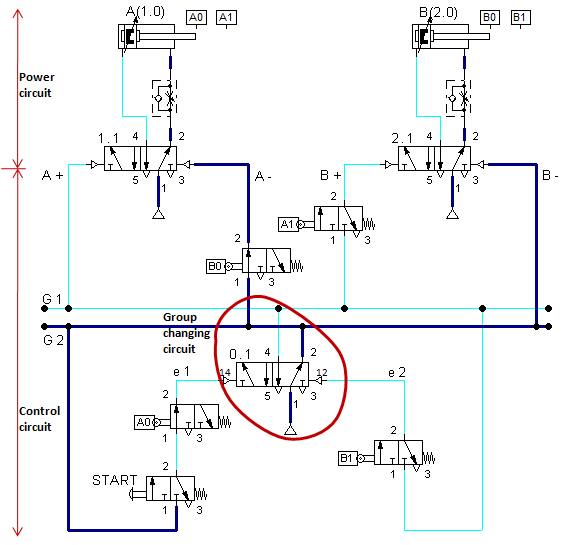
Most practical pneumatic systems involve multiple actuators (cylinders, semi-rotary actuators, etc.), which carry out the desired control tasks when operating in specified sequences. Double-pilot directional control (DC) valves are used as final control elements to control the forward and return strokes of the actuators. Sensors are used to confirm the actuator positions and provide signals... Continue Reading →
In the electrical actuation of a hydraulic valve, the necessary actuating force is obtained electrically with the help of a solenoid. The off-centre core of the solenoid coil is pulled towards the centre of the coil when the electric current is passed through it. This discrete movement of the core is used to actuate the... Continue Reading →
The article looks at the basics of pressure control valves for educational use and is presented here to refresh your memory. Hope you can recall the functions, circuits, and applications of pressure control valves. Pressure control valves are used in hydraulic systems to obtain pressure-related control functions. Pressure control valves can be categorized into: (1)... Continue Reading →
Hydraulic filters are vital components in hydraulic systems, ensuring they operate at peak performance and reliability. These filters effectively remove contaminants such as dirt, dust, and metal particles from the hydraulic fluid, which can otherwise lead to system failures or reduced efficiency. This article delves into the various construction features of hydraulic filters, highlighting the materials... Continue Reading →