The schematic diagram of a typical pneumatic system is in the accompanying figure. Basically, the system is composed of a power source, control valves, and work elements. The power source can broadly be classified into compressed air generation, primary air treatment, storage, air distribution, and secondary air treatment. A compressor is a device for converting mechanical energy into pneumatic energy. The compressed air, as delivered by the compressor, is contaminated to a widely varying degree. The contamination consists of dust and humidity from the atmospheric air taken in by the compressor and the particles originating within the compressor, such as the residues of lubricants and mechanically abraded particles. The heat developed during the compression may lead to undesirable oxidation and a combination of dirt particles in the air. It is essential to have high-quality compressed air to promote reliable and efficient operation of pneumatic components. To be suitable for any industrial use, the compressed air must be subjected to preparation using components such as an after-cooler, filters, a dryer, a receiver tank, and a Filter, Regulator, and Lubricator (FRL) unit. The distribution system of the compressed air must be properly sized and configured.

The after-cooler will reduce the compressed air temperature to approximately 15 to 25 0C above ambient. The filter units are installed in a graded manner for the removal of solid contaminants as well as moisture. The dryer is used to dehydrate compressed air. The air receiver tank assists in smoothening demand surges and further cooling the compressed air and the consequent water collection. The ring main network ensures largely uniform pressure conditions towards the downstream side of the system. The FRL unit is used at the end of the power source to obtain compressed air, which is finely filtered, dried, regulated, and lubricated just before entering a machine or tool. A pneumatic actuator is an output device for converting energy in the compressed air to produce a linear or rotary motion and/or apply a force. It is a device to make power and motion available to an automated system, machine, or process. The pneumatic system requires valves to control or regulate the flow of the pressurized air from the compressor to various actuators.
Fluidsys Training Centre Pvt. Ltd.
Bangalore, India
Fluidsys Training Centre, Bangalore, offers long-term and short-term training courses in pneumatics and hydraulics.
Long-term course:
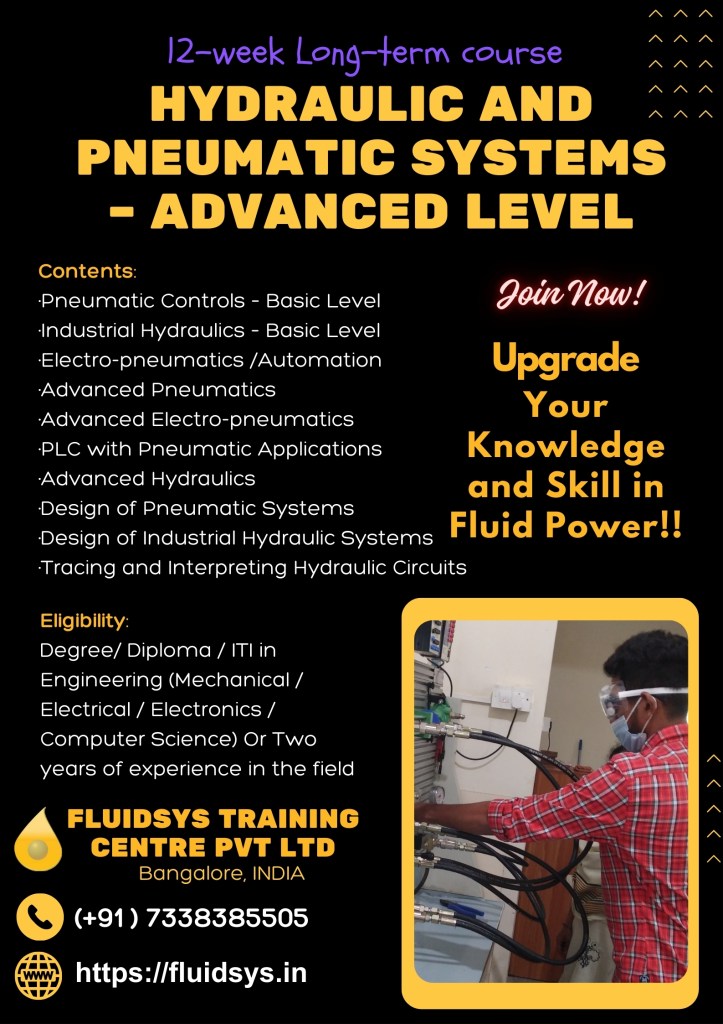
The 12-week long-term course, namely Pneumatics & Hydraulics – Advanced Level, is meant for Graduates and Diploma holders in Mechanical / Electrical / Electronics / Computer science who can attend the course to become complete fluid power professionals.
Brief Course Content (Pneumatics & Hydraulics – Advanced Level):
Pneumatics: Safety practices, Industrial prime movers, Compressed air generation and treatment, Pneumatic actuators, Valves and control circuits, Electro-pneumatics, Multiple-actuator pneumatic and electro-pneumatic circuits, Pneumatic applications, Design, and Maintenance and troubleshooting of pneumatic systems.
Hydraulics: Hydraulic safety, Hydraulic fundamentals, Fluids, Filters, Power packs, Pumps, Pressure relief valves, Linear actuators, Rotary actuators, Hydrostatic transmission (HST), Directional control valves, Non-return valves, Flow control valves, Pressure Control Valves, Accumulators, Seals, Fluid conductor system, Electro-hydraulics, Proportional valve system, Servo valve system, Basics of hydraulic cartridge valve systems, Load Sensing Systems, Applications of hydraulic systems, Preventive maintenance & troubleshooting, and Design of hydraulic systems.
Programmable Logic Controllers (PLCs)
Employability Skills: Stress Management, Decision Making & Problem-Solving, Team Building, Interpersonal Skills, Leadership, Time Management, Communication Skills, and Emotional Intelligence.
Short-term Courses:
- Industrial Hydraulics – Basic Level (10 days)
- Design of industrial hydraulic systems (4 days)
- PLC (OMRON) (5 days)
- Pneumatic controls –Basic level (5 days)
- Eletro-pneumatics and automation (5 days)
Need-based Courses:
Apart from the scheduled courses, the centre conducts tailor-made and need-based training courses in Pneumatics and Hydraulics.
The details of the course calendar, course contents, course fee, etc. can be obtained by contacting us or visiting our website.
Fluidsys Training Centre Pvt. Ltd., Bangalore, India
Mob: +917338385505
email: info@fluidsys.org | Website: https://fluidsys.org


 FLUIDSYS TRAINING CENTRE PVT LTD
Leave a comment